The Evolution of a Constitutional Remedy in India

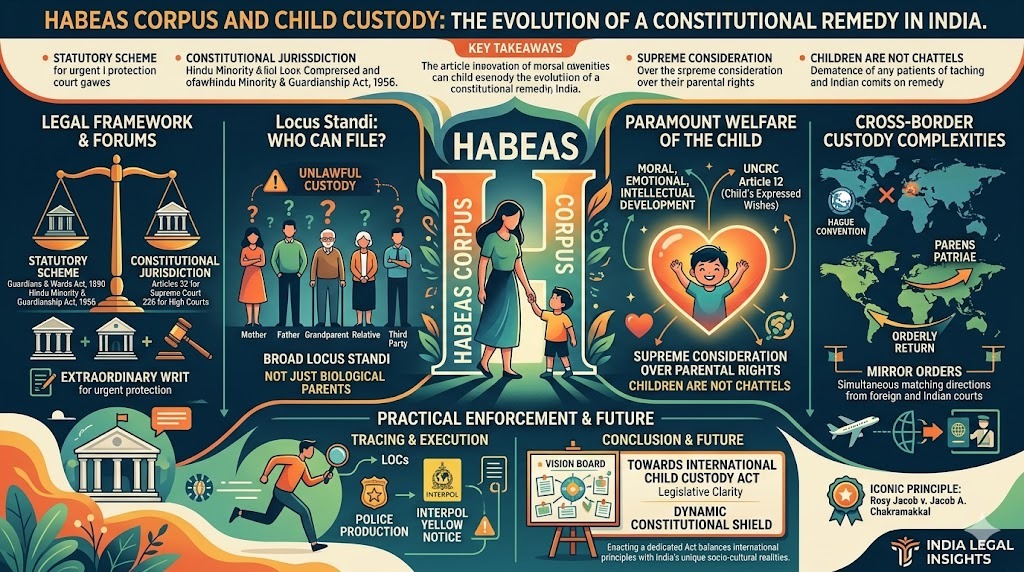
The Evolution of a Constitutional Remedy in India
When we think of habeas corpus, we usually picture a prisoner challenging illegal detention by the State. However, this constitutional writ has evolved into one of the most powerful tools available to a parent whose child is being wrongfully withheld—whether by a spouse, a relative, or someone across international borders. Over the years of litigation, the Supreme Court of India and various High Courts have dramatically reshaped this writ into a nuanced instrument of child protection.
The writ of habeas corpus in custody matters does not exist in a vacuum; it operates as an overlay on a substantive statutory scheme comprising the Guardians and Wards Act, 1890 (GWA), and the Hindu Minority and Guardianship Act, 1956 (HMGA).
The jurisdiction to issue this writ stems from Article 226 (High Courts) and Article 32 (Supreme Court) of the Constitution. While High Courts are the primary forum for such petitions, the Supreme Court directly entertains habeas corpus petitions under Article 32 in exceptional custody matters involving fundamental rights violations. Practitioners must carefully navigate the boundaries between these forums, as findings in a High Court writ may attract the doctrine of res judicata, barring a subsequent Article 32 petition on identical grounds unless new circumstances arise.
Unlike traditional civil custody suits, the writ of habeas corpus in custody disputes allows for broader locus standi. It is not restricted merely to biological parents. Grandparents, maternal aunts, or other relatives can file the petition if they can demonstrate that the child is in illegal or unlawful custody. The Supreme Court in Syed Saleemuddin v. Dr. Rukhsana1 clarified the standing of individuals, establishing that the paramount consideration is the legality of the custody and the welfare of the child, allowing courts to entertain petitions from concerned relatives when the situation demands.
Section 25 of the GWA provides a dedicated civil remedy for the arrest and delivery of a ward. A critical choice-of-remedy question arises: when should one bypass the Family Court and invoke writ jurisdiction? In Shilpa Aggarwal v. Aviral Mittal2 the Supreme Court held that the High Court is not bound to relegate parties to the family court merely because civil remedies exist, where the welfare of the child demands immediate action, the extraordinary jurisdiction under Article 226 must be exercised. However, courts have increasingly frowned upon the use of habeas corpus to bypass already pending Section 25 proceedings, asserting that the writ should be reserved for urgent, extraordinary circumstances rather than routine custody battles.
No principle is more deeply entrenched in this field than the welfare of the child. In Rosy Jacob v. Jacob A. Chakramakkal3 the Supreme Court laid down the iconic principle that children are not mere chattels or playthings. The absolute right of parents has yielded to the welfare of the child as a human being. In Gaurav Nagpal v. Sumedha Nagpal4 the Court expressly extended this standard to habeas corpus proceedings, establishing that the child's welfare is the supreme consideration, overriding the competing rights of the parents.
Welfare must encompass the child's moral, emotional, and intellectual development. In Nil Ratan Kundu v. Abhijit Kundu5 the Court emphasized that the expressed wishes of the child carry significant weight. This aligns with India's international obligations. Having ratified the UN Convention on the Rights of the Child (UNCRC) in 1992, India is bound by Article 12, which mandates giving due weight to the child's views commensurate with their age and maturity.
India is not a signatory to the Hague Convention on the Civil Aspects of International Child Abduction, 1980. The Law Commission of India’s 218th Report (2008) recommended ratification, but India has resisted, largely due to concerns over protecting Indian spouses (often women in NRI marriages) fleeing domestic abuse abroad. This non-ratification creates complex incentive problems, occasionally making India a safe haven for parental abduction, and inviting intense diplomatic pressure and the formulation of bilateral MoUs.
In the absence of a treaty, Indian courts have developed a sophisticated, framework.
In Dhanwanti Joshi v. Madhav Unde6 the Court undertook a comprehensive survey of the Hague Convention framework and held that Indian courts exercise independent parens patriae jurisdiction, and are not bound to treat return to the country of habitual residence as automatic, the best interest of the child is the decisive test. In V. Ravi Chandran v. Union of India7 the Court held that where a child has been removed from its habitual residence in violation of a valid foreign order and has not had opportunity to develop roots in India, it would be proper to return the child so that the parties may pursue modification of custody orders before the competent foreign court.
The practice of "mirror orders", by which both the Indian and the foreign court simultaneously issue matching interim directions to secure safe return without prejudging custody was adopted by the Supreme Court in Surya Vadanan v. State of Tamil Nadu8 where the Court also held that the High Court erred in declining to issue a habeas corpus writ in respect of children who were wards of the UK court brought to India in breach of that court's orders.
A rapidly growing category of litigation involves children holding Overseas Citizen of India (OCI) cards or foreign citizenship. In Yashita Sahu v. State of Rajasthan9 and Vasudha Sethi v. Kiran V. Bhaskar10, the Supreme Court addressed territorial jurisdiction, ruling that the writ of habeas corpus lies even when the child is a foreign citizen or OCI cardholder temporarily in India, provided the court determines that the child's return aligns with their best interests.
In Elizabeth Dinshaw v. Arvand M. Dinshaw11 the Supreme Court, dealing with a child abducted from the United States to India in violation of a US court order, set out the governing standard:
"Whenever a question arises before a court pertaining to the custody of a minor child, the matter is to be decided not on considerations of the legal rights of parties but on the sole and predominant criterion of what would best serve the interest and welfare of the minor."
The grant of a writ is only half the battle; enforcement is operationally critical. When a respondent absconds or conceals the child, practitioners must utilize auxiliary mechanisms:
• Domestic Enforcement: Courts rely on contempt jurisdiction and direct police production orders. Child Welfare Committees (CWCs) under the Juvenile Justice Act, 2015, are also mobilized to ensure the safe transition and temporary protection of the child.
• International Tracing: In cross-border abductions, the Ministry of External Affairs (MEA), the Central Bureau of Investigation (CBI), and Interpol (via Yellow or Red Notices) play critical roles. Look-Out Circulars (LOCs) are frequently issued to prevent the child from being moved across borders. However, in Smriti Madan Kansagra12 the Supreme Court condemned the arbitrary impounding of passports as a pressure tactic, urging a balanced approach to international tracing.
The evolution of habeas corpus in Indian child custody law reflects a humane shift from technical legality to a fact-sensitive, welfare-driven remedy. However, significant lacunae remain, particularly in cross-border disputes where the tension between comity and independent welfare assessments creates unpredictability.
To resolve these inconsistencies, Parliament should consider enacting a dedicated International Child Custody Act that balances the principles of the Hague Convention with the unique socio-cultural realities of Indian families. Until legislative clarity is achieved, the writ of habeas corpus remains the most dynamic and vital constitutional shield for children caught in the crossfire of custody battles.
1. Syed Saleemuddin v. Dr. Rukhsana, (2001) 5 SCC 247 (Held: Established the standing of third parties/relatives to file habeas corpus in custody matters).
2. Shilpa Aggarwal v. Aviral Mittal, (2010) 1 SCC 591 (Held: High Courts need not relegate urgent custody matters to Family Courts merely because civil remedies exist).
3. Rosy Jacob v. Jacob A. Chakramakkal, (1973) 1 SCC 840 (Held: Children are not chattels; parents' absolute rights yield to the child's welfare).
4. Gaurav Nagpal v. Sumedha Nagpal, (2009) 1 SCC 42 (Held: Welfare of the child is the supreme consideration in habeas corpus proceedings).
5. Nil Ratan Kundu v. Abhijit Kundu, (2008) 9 SCC 413 (Held: The child's expressed wishes carry weight; welfare includes moral and emotional development).
6. Dhanwanti Joshi v. Madhav Unde, (1998) 1 SCC 112 (Held: Indian courts exercise independent parens patriae jurisdiction outside the Hague Convention).
7. V. Ravi Chandran v. Union of India, (2010) 1 SCC 174 (Held: Ordered return of a child lacking roots in India to the habitual residence court).
8. Surya Vadanan v. State of Tamil Nadu, (2015) 5 SCC 450 (Held: Adopted the "mirror order" doctrine and emphasized comity of courts).
9. Yashita Sahu v. State of Rajasthan, (2020) 3 SCC 67 (Held: Writ lies for NRI/OCI children; courts must evaluate if return serves best interests).
10. Vasudha Sethi v. Kiran V. Bhaskar, (2022) SCC Online SC 43 (Held: Clarified territorial jurisdiction and welfare analysis in international custody disputes).
11. Elizabeth Dinshaw v. Arvand M. Dinshaw, (1987) 1 SCC 42 (Held: An abducting parent cannot claim advantage from their illegal act of removal).
12. Smriti Madan Kansagra v. Perry Kansagra, (2021) 12 SCC 289 (Held: Condemned arbitrary passport impounding).