
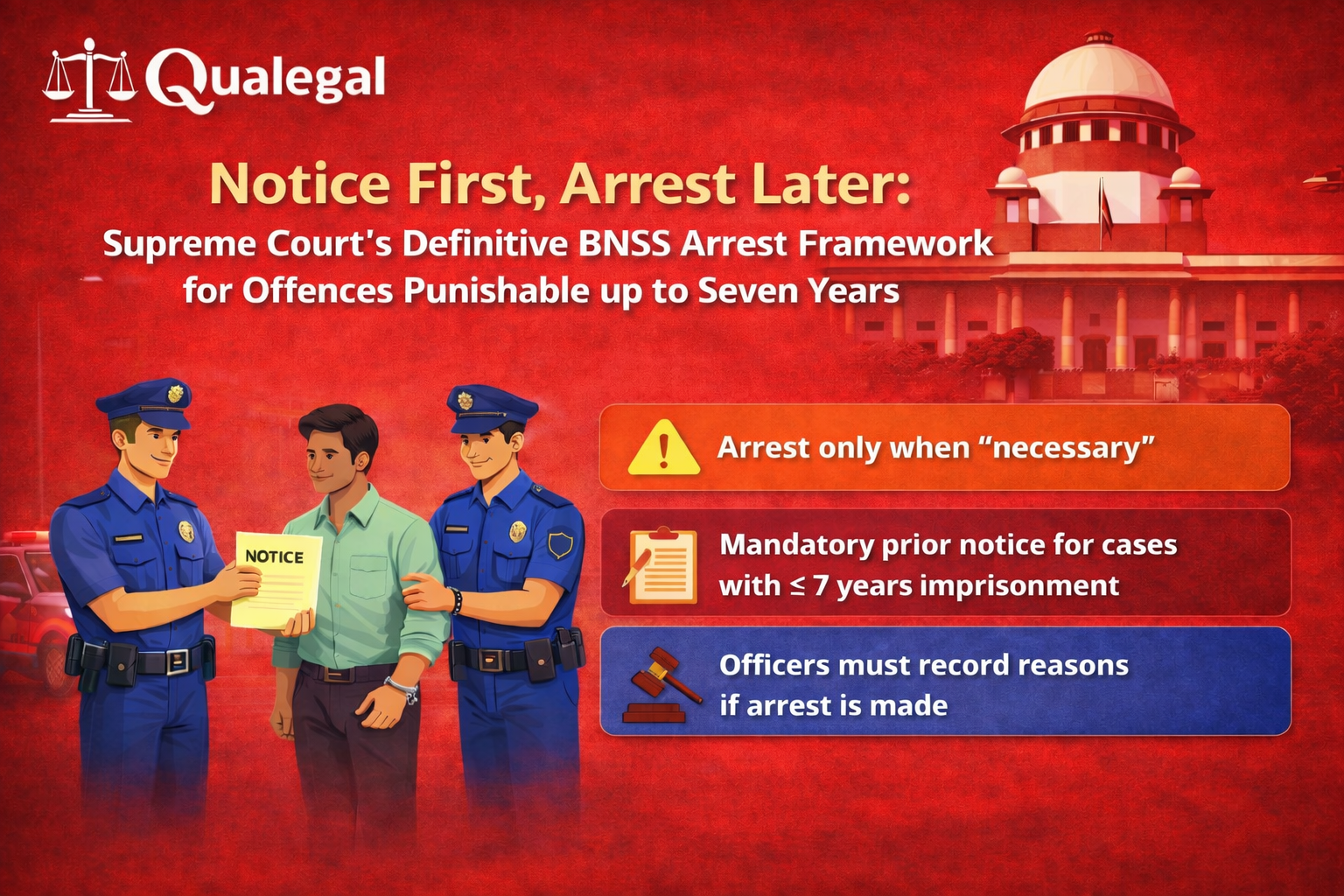
Notice First, Arrest Later: Supreme Court’s Definitive BNSS Arrest Framework for Offences Punishable up to Seven Years
Introduction: Arrest Power and Personal Liberty in the BNSS Era
The authority to arrest is one of the most serious powers conferred upon the State. While it serves a legitimate investigative purpose, it simultaneously infringes upon personal liberty, dignity, reputation, and social standing, which are squarely protected under Article 21 of the Constitution of India. For this reason, constitutional courts have consistently emphasized that arrest should never become a matter of routine or administrative convenience.
Despite repeated judicial warnings, arrests for offences punishable with imprisonment for up to seven years have frequently continued to be made mechanically, often at the very inception of the investigation. This tendency prompted renewed scrutiny after the enactment of the Bharatiya Nagarik Suraksha Sanhita, 2023 (BNSS), particularly with respect to Section 35, which replaced the arrest framework under the Code of Criminal Procedure, 1973.
The Supreme Court’s decision dated 15 January 2026 in Satender Kumar Antil v. Central Bureau of Investigation, M.A No. 2034 of 2022 finally settles the legal position. The Court has categorically held that issuance of notice under Section 35(3) BNSS is the governing rule for offences punishable with imprisonment up to seven years, and that arrest is an exception, permissible only where custody becomes unavoidable for the purposes of investigation.
The Core Issues Before the Supreme Court
The Supreme Court framed two seminal questions.
- 1. Whether notices under Section 35(3) BNSS are mandatorily required in all cases involving offences punishable with imprisonment up to seven years; and
- 2. Whether, in the absence of the circumstances enumerated under Sections 35(1)(b)(i) and 35(1)(b)(ii) BNSS, an arrest for such offences can be legally justified.
These questions arose because, in practice, the notice mechanism under Section 35(3) was often diluted by invoking the power of arrest upon merely recording “reasons for arrest,” thereby undermining the legislative intent of the BNSS.
Arrest Is Not the Essence of Investigation
At the outset, the Supreme Court revisited a fundamental but often overlooked principle: an investigation does not begin or end with an arrest.
Relying on the classic exposition of law in State of U.P. v. Bhagwant Kishore Joshi (1964) 3 SCR 71, the Court reiterated that investigation is a comprehensive process that includes collection of evidence, examination of witnesses, searches, seizures, and formation of an opinion as to whether a charge-sheet should be filed.
The Court underscored that arrest is merely one possible step within this process, and not an indispensable one. This conceptual clarity forms the foundation of the Court’s interpretation of Section 35 BNSS.
How Section 35 BNSS Is Structured
Arrest Is a Discretion, Not an Obligation
Section 35(1) BNSS uses the expression “may arrest,” clearly indicating that arrest is discretionary and not mandatory, even in cognizable offences. The Court held that the legislature consciously avoided making arrest the default response.
Dual Conditions for Arrest Under Section 35(1)(b)
For offences punishable with imprisonment of up to seven years, arrest under Section 35(1)(b) is permissible only when both conditions are satisfied:
- 1. The police officer has reason to believe that the person has committed the offence; and
- 2. The officer is satisfied that arrest is necessary for at least one specified purpose, such as preventing further offences, ensuring proper investigation, preventing evidence tampering or witness intimidation, or securing the accused’s presence before court.
The Court has clarified that these two requirements are cumulative. Mere suspicion or the gravity of allegations is insufficient.
Recording of Reasons Is Statutorily Mandated
Section 35 requires an officer to record reasons in writing for making an arrest or for not making an arrest and issuing a notice instead. This requirement ensures transparency and allows courts to meaningfully examine the legality of an officer’s decision.
Section 35(3) BNSS: Notice as the Rule
The most significant aspect of the judgment is the Court’s interpretation of Section 35(3) BNSS, which mandates the issuance of a notice of appearance where arrest is not required.
The Supreme Court held that the issuance of a notice under Section 35(3) is the default legal position for offences punishable with imprisonment of up to seven years.
An arrest cannot be treated as the starting point of an investigation. A police officer must first assess the necessity; if arrest is not strictly required, notice must follow.
Effect of Compliance With Notice: Section 35(5)
Section 35(5) BNSS assumes great importance once the notice under Section 35(3) is issued.
The Court held that where a person complies and continues to comply with the notice, arrest is legally prohibited unless the investigating officer subsequently forms a reasoned opinion that is recorded in writing indicating that arrest has become necessary.
Non-Compliance Does Not Mean Automatic Arrest
The Supreme Court clarified that arrest does not automatically follow non-compliance with a notice.
Under Section 35(6), arrest remains discretionary and not mandatory. The investigating agency must still form an opinion that arrest is necessary.
Arrest After Notice: The “Fresh Material” Requirement
One of the most significant contributions of this judgment is the formulation of the “fresh material” requirement.
The Court held that when arrest is sought after the issuance of a notice under Section 35(3), the police cannot rely on the same circumstances that existed at the time of issuing notice.
An arrest must be based on new materials or subsequent developments that were not previously available.
Arrest Cannot Be for “Asking Questions”
The Supreme Court issued a clear warning against custodial interrogation as a matter of convenience. It held that arrest must be treated as a measure of last resort and not as a tool to facilitate questioning.
Harmonisation With Arnesh Kumar and Earlier Satender Kumar Antil Decisions
The Court clarified that the BNSS does not dilute the safeguards laid down in Arnesh Kumar v. State of Bihar (2014) 8 SCC 273.
The decision also builds upon the Court’s earlier observations in Satender Kumar Antil v. CBI (2022) 10 SCC 51.
Conclusion
The decision in Satender Kumar Antil v. CBI marks a decisive step in restoring the balance between effective investigation and personal liberty under the BNSS regime.
By affirming that notice precedes arrest, insisting on strict necessity, and requiring fresh material for post-notice custody, the Supreme Court reinforced the constitutional promise that deprivation of liberty must always be justified, proportionate, and exceptional.
The message is unmistakable: arrest is not a matter of convenience; it is a measure of last resort.